
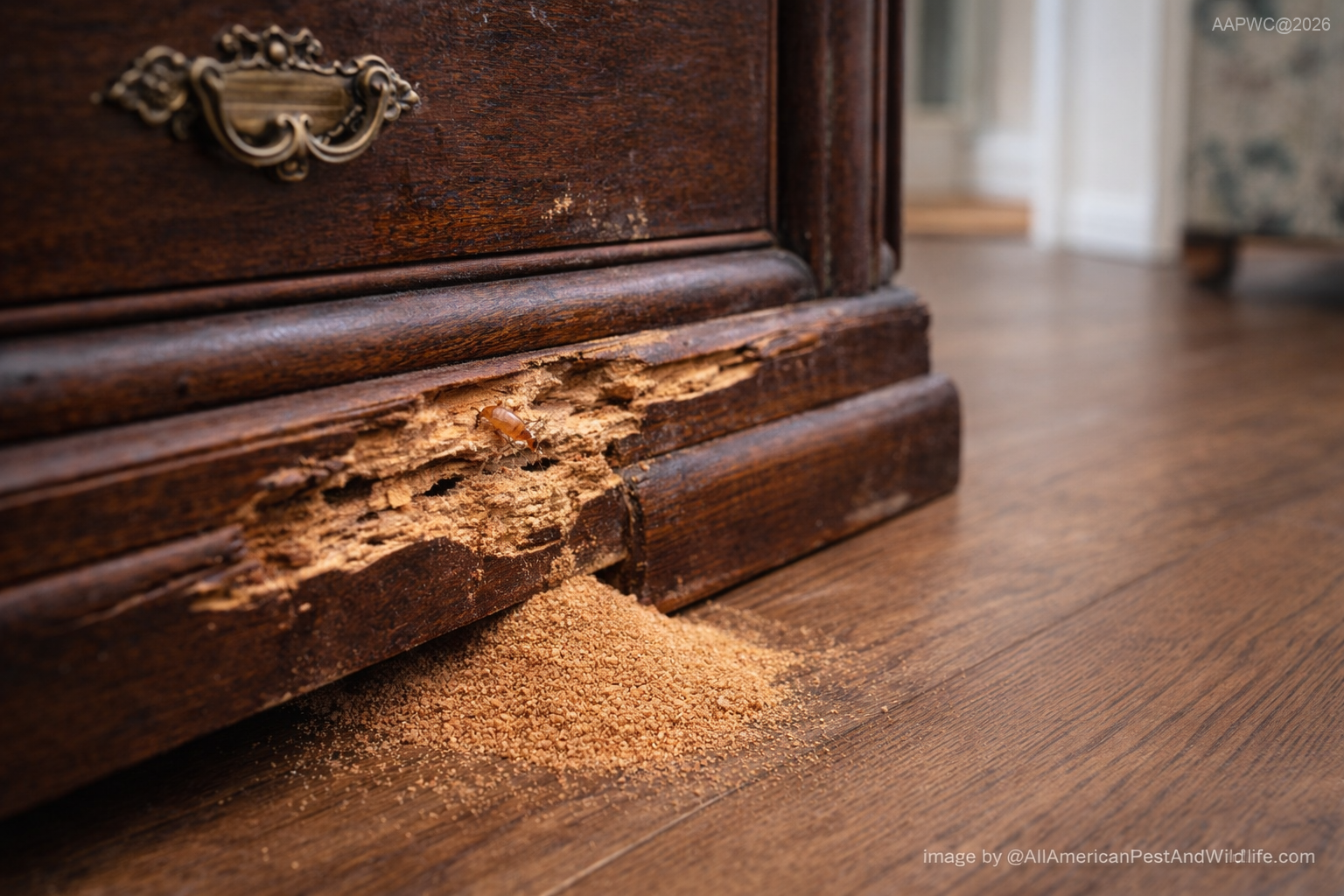

Drywood Termite Treatment in Louisiana
Drywood Termite Treatment in Louisiana protects homes from a silent form of structural damage that operates without soil contact, without mud tubes, and often without obvious warning.
Unlike subterranean termites that travel through soil, drywood termites live directly inside the wood they consume. They build colonies within framing, trim, furniture, and attic rafters. They do not require ground contact. They do not need moisture-rich soil. They establish themselves entirely within the structural materials of a home.

Same-day service available
What Are Drywood Termites?
Drywood termites:
- Live entirely inside wood
- Do not build mud tubes
- Produce pellet-like droppings called frass
- Create small “kick-out” holes
- Infest structural lumber and furniture
They extract moisture from the wood itself, allowing them to survive in attics, wall voids, door frames, and hardwood flooring.

Why Drywood Termites Are a Serious Risk in Louisiana
Louisiana’s coastal humidity and warm temperatures create ideal swarming conditions. While they do not require soil moisture like subterranean termites, drywood colonies still thrive in climate-controlled homes and exposed attic framing.
They enter through:
- Attic vents
- Cracks in fascia boards
- Exposed eaves
- Gaps in siding
- Wooden furniture brought indoors
Once inside, colonies grow slowly but steadily.
Damage accumulates quietly.
By the time frass appears, feeding has often been active for years.
Are Drywood Termites Common?
Yes. Drywood Termite Treatment in Louisiana is increasingly necessary, particularly in coastal regions and areas like New Orleans, LA, where warm temperatures and elevated humidity create ideal swarming conditions.
Drywood termites live entirely inside the wood they infest. Louisiana’s long summers, mild winters, and consistent humidity allow colonies to establish inside attics, fascia boards, trim, hardwood flooring, and even furniture. In cities like New Orleans, historic wood-frame architecture and older construction methods increase vulnerability to drywood infestations. If your in southeast Louisiana Go Tent-Free with APPWC

How Drywood Infestations Begin
Swarmers emerge typically late summer through early fall in Louisiana. They are attracted to light and often mistaken for flying ants.
After landing, they shed wings and bore directly into exposed wood.
No soil required.
No ground tunnel needed.
Just a tiny opening.
Colonies develop internally, hollowing beams from the inside outward.
Seeing Signs of Frass?
Same-day service available

Signs You Need Drywood Termite Treatment in Louisiana
Look for:
- Piles of pellet-shaped droppings
- Small round exit holes
- Bubbling paint
- Tight-fitting doors
- Sagging trim
- Hollow sounding beams
- Attic wood damage
Unlike subterranean termites, you will not see mud tubes.
The absence of tubes does not mean absence of termites.
Treatment Options
Drywood Termite Treatment in Louisiana may include:
- Localized wood injection
- Foam void applications
- Borate surface treatments
- Heat treatments
- Whole-structure fumigation
Each method depends on infestation size and spread. Learn how you can Go Tent-Free with APPWC

Comprehensive Protection:
At All American Pest & Wildlife Control, Our Tent-Free Program is an integrated approach that reduces recurrence, strengthens long-term defense, and protects the structural integrity of your home year after year. At AAPWC we keep your home Red, White and Termite Free with our Termite Control Options.
Why Professional Treatment Matters
DIY aerosol sprays rarely penetrate galleries. Surface treatments do not reach internal chambers.
Professional Drywood Termite Treatment in Louisiana involves:
- Moisture readings
- Borescope inspections
- Structural mapping
- Targeted applications
- Long-term monitoring
Preventative care is always less expensive than structural replacement. Go Tent-Free With AAPWC
Service Areas for Drywood Termite Treatment in Louisiana
Service Areas Include:
- Slidell, La
- Pearl River, La
- Lacombe, La
- Mandeville, La
- Covington, La
- Madisonville, La
- Abita Springs, La
- Folsom, La
- Bush, La
- New Orleans, La
- View our full Service Area

Often Asked Questions about Drywood Termites
Ask About Our Tent-Free Drywood Termite
Are drywood termites common in Louisiana?
Yes, especially in coastal and humid regions. They frequently infest attics and wood trim.
How are drywood termites different from subterranean termites?
Drywood termites live entirely in wood. Subterranean termites require soil contact.
What does termite frass look like?
It resembles tiny wood-colored pellets. They are six-sided and uniform.
Can drywood termites infest furniture?
Yes, especially solid wood furniture brought from untreated locations.
Do drywood termites require moisture?
They extract moisture from wood fibers. They do not need soil.
When do drywood termites swarm in Louisiana?
Late summer and early fall evenings are most common.
Late summer and early fall evenings are most common.
Yes, long-term feeding weakens beams and trim.
Do drywood termites spread quickly?
They spread slower than subterranean species but still cause serious damage over time.
What is whole-structure fumigation?
It is a tented gas treatment that penetrates all wood members.